Sunday, October 19, 2014

Week Eight: Stereotypes and the Ethics of Representation

This week we are discussing the use of stereotypes in gaming, animation, and comic culture. I think stereotypes are something that are fought for time and time again by diehard gaming, cartoon and other media enthusiasts, vehemently standing by the fact that they are necessary in order for the point to get across, necessary for people to better understand the more minor parts of a story so that the reader can now focus on the 'bigger picture' that whoever is trying to portray.

I think this is entirely false. I believe that stereotypes are created by people in positions of power and privilege to simplify, delegitimize and dehumanize them. I think that they're a lazy excuse not to do more research, be more inclusive, or make any attempt at opening up the gaming, animation or comic community to a wider audience. People who think that 'stereotypes exist for a reason' are often the same people who think that games, movies, comics, etc. don't have female protagonists because women don't play games or watch movies or read comics. They're often the same people who think that only white men created beautiful classical works of art, literature and otherwise because women and people of color 'just didn't do stuff like that'. They're often the same people that think that women and people of color still aren't making the best comics or cartoons or games because of no specific reason.
These are the kind of people who are satisfied with the answer 'that's just the way it is' without thinking of why something is that way. They don't look past the reason why stereotypes exist or why classical women/POC painters aren't recognized in history or why every blockbuster movie just has to have a white male main character.
Society actively erases the work of people who aren't the privileged ones in the equation. Many people who have the power to recognize an artist or give a game idea the greenlight or determine if there should be an option to play a woman character as well as a male character in a certain game aren't interested in diversity or being inclusive because they find it inconvenient and threatening to their position in privilege-- because, yes, many of the people who can make these decisions were put there because of their privilege. It's a cycle, and it's not a view that is visible to someone who is on the bottom of the mountain, so to speak.

Stereotypes are created in an arbitrary way and enforced by constant use over generations. It's possible to break down a stereotype by understanding that these traits are ones that people of many different races and genders possess, and instead of being a label for these traits they are simply traits that any kind of human is able to possess. Many great works have been created in the past century by actively going against stereotyping and breaking the boring bounds of what someone thinks would be a normal stereotype. I think there are better ways to immediately communicate an idea besides offensive stereotypes-- and to refer back to them time and time again is a lazy practice. So no, I don't think they are necessary to communicate an idea. There is never a need to be offensive or dehumanize an entire group of people to tell your space opera story.

Week Seven: Legitimation of the Comics


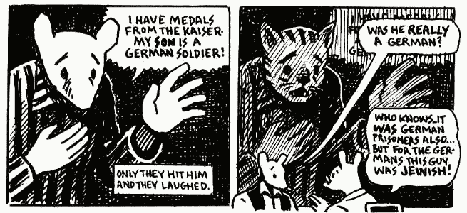
This week, I read volumes 1 & 2 of Maus, by Art Spiegelman. Having never read it before, it became clear to me now why it is considered such an important memoir by many. Maus is a digestible, hard-hitting and very real work by a cartoonist who is documenting the tales of his grandfather who was a Jewish prisoner in Auschwitz during WWII. For many, it is sometimes hard to find documents of the war that don't sound so wholly gruesome and unbelievable that it almost seems like a work of fiction. To someone who has never experienced the horrors of war, there can be a disconnect between retellings of the war and fiction they've consumed that seems like war, and the feeling that those two things give.

However, Maus does a great job of making the war seem like something real that happened and affected the people involved as well as their posterity. Because it is told from the eyes of the narrator hearing the story retold from his grandfather, it gives the experience of the war a faraway feel, but at the same time something that really happened as told by someone you trust dearly, like your grandfather.

I think another victory of these comics are the way the characters are represented visually in the book. The characters are different races of animals-- mice, pigs, cats-- representing the ethnicity of the characters. It drives home the point of discrimination and categorization by the Nazis home in a very simple way by doing this. As well as this, by turning the characters into cartoonish animals, it gives the story a level of accessibility that I don't think it would have, had the animals be specific caricatures of the people they represent. With such little identifying features separating them, the reader is able to project themselves and/or their family into the roles of the characters in Maus. I think this feature helps give the comic the level of accessibility it needs in order to reach such a wide audience, as it did.

Week Six: Underground Comix


This week we focused on the underground comics of the '60s. I read a few of Robert Crumb's comics, such as Whiteman and other shorts. I really love the underground comics movement, as I believe it jumpstarted a lot of what I find myself interested in today, being the indie & small-press comic culture. Underground comics were the first time that comics really became open to anyone who wanted to create and publish. No longer did anyone have to depend on big-time comics publishers or newspapers to serialize their comics, as many artists started to show their work in smaller, underground magazines, or simply to self-publish their own work.
That being said, much of the driving force for these creators to make these comics was the Comics Code Authority, which was in essence a censor on comics, not allowing any sort of published comic to show any sort of 'smut'. Underground comics was a way for comics creators to kind of push back and make comics explicitly banned by the code as a way to continue to explore creative freedom through the medium of comics, no matter what the government regulation was. That being said, many underground comics were very explicit, (especially Crumb's) in racial, sexual or drug-related ways. It was the first time that there had been a whole genre of comics that were very strictly for adults; the age-inclusiveness was not at all flexible. I feel that this kind of expanded people's understanding of comics and what they felt could be done in the visual medium of comics.

Crumb created many personal comics as well, which not many creators had done before. He made short comics based on his own personal experience of drug use and otherwise, as well as injected subject matter he found interesting or enthralling into his work (namely, the types of women he seemed to enjoy). This kind of personal touch in comics was something that hadn't been seen as much before this era, and is a trend that continued well into this era of comic creators; many incredible works have been made in the comic field that are memoirs or simply draw on the experience of the artist in a deep way in some form or another.

Wednesday, October 1, 2014

Week Five: Emergence of the Graphic Novel


This week I read Blankets, by Craig Thompson. I've never read the book in its entirety before, and I was surprised. I didn't expect a religious memoir at first, and I didn't entirely relate, but as I read on I think anyone who has even ever gone to church before (or even, has ever been a teenager or had a first love before) can probably relate to this novel. And honestly, the experience of reading the book isn't even all about whether or not you can relate to the subject material. What is important is that you are experiencing a very deep and personal story that the author has to tell, and he does it in such a down-to-earth and involving way that it's hard not to lose track of time while you are reading this book. I found myself starting to care about Craig's experiences and wonder how this played out and how it affected him later in life.

Blankets brought to mind another graphic novel memoir that stands out strongly in my mind to this day-- Stitches, by David Small. Stitches is gritty and delves deep into his complicated family life and how the events of his childhood impacted him later on. Thinking about it, it reminds me that one of the most engaging traits of a memoir-style graphic novel is how personally and deeply it can vibe with you. Something about the way that these people choose to visually portray these memories as well as how they tell them adds another layer of meaning to the entire experience. The way that many artists draw often ties in directly with their life experiences and the kind of person they are, even in the most subtle ways-- and when you add that to the fact that this person is using drawing to tell their personal stories, it's no wonder why these comic memoirs become so popular.

Tuesday, September 16, 2014

Week Four: The Comic Book

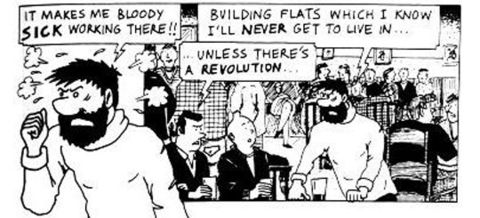
from a Tintin comic

Comic books are a form of comic that I didn't relate to as well growing up as a kid. I have never really been interested in superhero comics, which made up the majority of the comic books I had access to as a kid, and I never read the Archie comic books, either. Actually, the only comic books I ever read as a kid were the Archie Sonic the Hedgehog comic books, which...well... it is what it is.

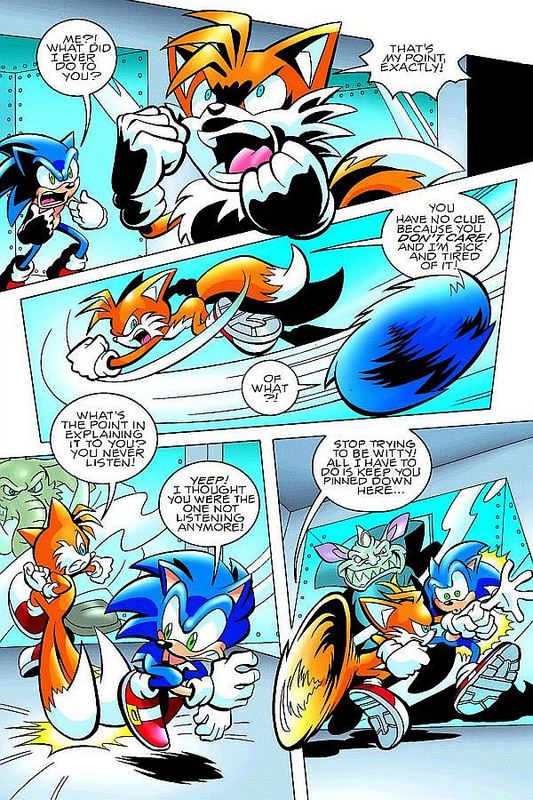
Sonic and Tails are fighting!


Anyways, I'm not proud of it, but there you go.
Even as bad as they were, I think reading the Sonic comics when I was younger really helped fuel my fire as far as being interested in comics goes. I loved all the character designs, colors and worldbuilding they had going on, and it made me want to create my own stories and design my own characters-- which I did, and for a really long time that was one of the things I loved to do most. I have tons and tons of bins filled with old weird character designs and story notes that I was all trying to turn into comics (none of them made it to the finished product, of course, but coming up with the stories was really my favorite part anyways).

In class we passed around some comic books, and I got my hands on a couple of war comics. Now, I'm not that into war comics at all, and especially not war comics done in the style of an action-hero comic book. I think my favorite war comic that I've ever read was Notes for a War Story, by Gipi.
Anyways, this comic was pretty interesting in the way that it was clearly not intended for children. The subject matter was extremely heavy and the content was pretty violent and definitely not kid friendly at all. I could tell that it was intended for an older audience, maybe even an audience that is at the age where they have relatives or even they themselves can relate to a war environment. I think this is one of my favorite things about comic books is that they can be made for people of all ages-- just like regular books can!!!

All and all I acknowledge and appreciate the appeal of comic books and their ability to tell longer-form stories, but I think the majority of the genres represented in Western comic books are just not the kind of genres that I am interested in (which is why I enjoy manga a lot more than most western comics books).

Monday, September 15, 2014

Week Three: The Comic Strip


Comic strips are one of my favorite mediums for comics, and the medium that very first got me into reading and drawing comics in the first place. I feel that I owe much of the joy in my life to my early days of reading the comic strips in the newspaper every day. This led me to reading certain comic books, western and otherwise, which eventually led me to the path that I continue to try and follow today of making comics.

Growing up, I'll admit it, I was a huge Garfield fan. I also loved other ones that appeared in my newspaper every day, like Get Fuzzy, Curtis, Pearls Before Swine, Shoe, and of course, Calvin and Hobbes. As I got older, I fell more into reading all kinds of different manga-- though as I entered college I became re-introduced to all kinds of amazing old comic strips and where they originated from. I was exposed to the long, beautiful, artful pages of Little Nemo, as well as the poetic comedy that was Krazy Kat. I had no idea about any of these comics when I was younger, but if I had, I was sure that I would have loved them. I was very much drawn back in to the comic form that I originally had fallen in love with in the first place, and I am still having a blast exploring all of the undiscovered goldmines of comic strips that I simply haven't been exposed to yet.

This week I chose to dive back into Calvin and Hobbes. Reading it as an adult, I find, is an entirely different experience than as a kid. When I was younger I focused on all the quick gags and the silly situations that Calvin and his tiger got themselves into. Now that I am older, the short, lucid moments in the comic are not lost on me. Truly one of the greatest strips in history.
Calvin and Hobbes is a concept that never got stale, or tired. Calvin always picked on the same girl, had the same childish stubbornness all kids his age have, had the same exasperated parents, the same lackadaisical tiger friend. I think what this strip has that others don't is an honest exploration of all the different facets of kidhood (which are countless) tied into the lucid thoughts a kid might have that marks the passage of time and his transition into an older, more thoughtful person. Every adult reading this comic had gone through this, and Watterson's beautiful ability to tell a concise story (or rather, a small, concise piece of a story) complimented the ideals he wanted to portray with grace. I know I just used a ton of flowery language, but I feel like out of the strips that deserve the attention, Calvin and Hobbes is unanimously one.

I personally want to delve back into comic strips a bit more-- concise storytelling is one of the best exercises you can do for yourself in comics.

Wednesday, August 27, 2014

Week Two: "Understanding Comics"


This week's reading was Scott McCloud's Understanding Comics. I read Making Comics by the same author years ago, when I was in high school-- when reading Understanding Comics I realized that they're very similar (I believe it's just a newer version) but the basic principles presented in both books are the same.

I swear by these books. I studied McCloud's comics thoroughly and I fully contribute the good footing I gained in comics early on to these books. The concept is very simple-- teaching how to make comics through showing it in comic format. It's genius. My favorite part about Understanding Comics is that it highlights the foundation and structure of comics. Of course you can bend and meld the rules into all different kinds of ways for yourself as a cartoonist, but there are a certain set of foundation skills that you must understand if you want your comics to meet a certain level of success. What I mean by this is, if your comic is really pretty but the panels aren't in the right order or don't read easily... that's a problem. If your word bubbles are illegible or jump all over the page, and the reader has to spend 5 or more minutes trying to decide which speech bubble they are supposed to read first-- that's a problem.
Understanding Comics addresses basic issues that, without proper understanding on the artist's part, can make for a very hard-to-read, very unsuccessful comic that is disconnected from its reader. You don't want to alienate your reader when they read your comic-- quite the opposite, actually. I believe if you don't understand these basic foundations, nobody will want to read your comic, and in a way, you've failed. Understanding Comics addresses these issues in a fun, easy-to-read, relatable, and intuitive way-- demonstrating exactly what it's trying to teach! I can't explain how much I love these books. I feel like I owe them so much.


Whenever I have a friend that tells me they want to start making comics, or want to learn how to make them, I automatically offer to lend them my copy of Making Comics (many times I will just lend it to them anyways in hopes that they will read it). I feel like it gave me the tools I needed to build on top of, and taught me the basic skills of keeping my comics intuitive and legible. I feel like I had gotten much farther ahead much quicker by reading this book-- it's nothing you couldn't figure out by looking at any other successful comic and noticing what makes them good-- however it teaches you up front and I appreciated that. Anyways, I really love these books and gush about them anyways, so it's nice to be able to do the same thing for a class.